

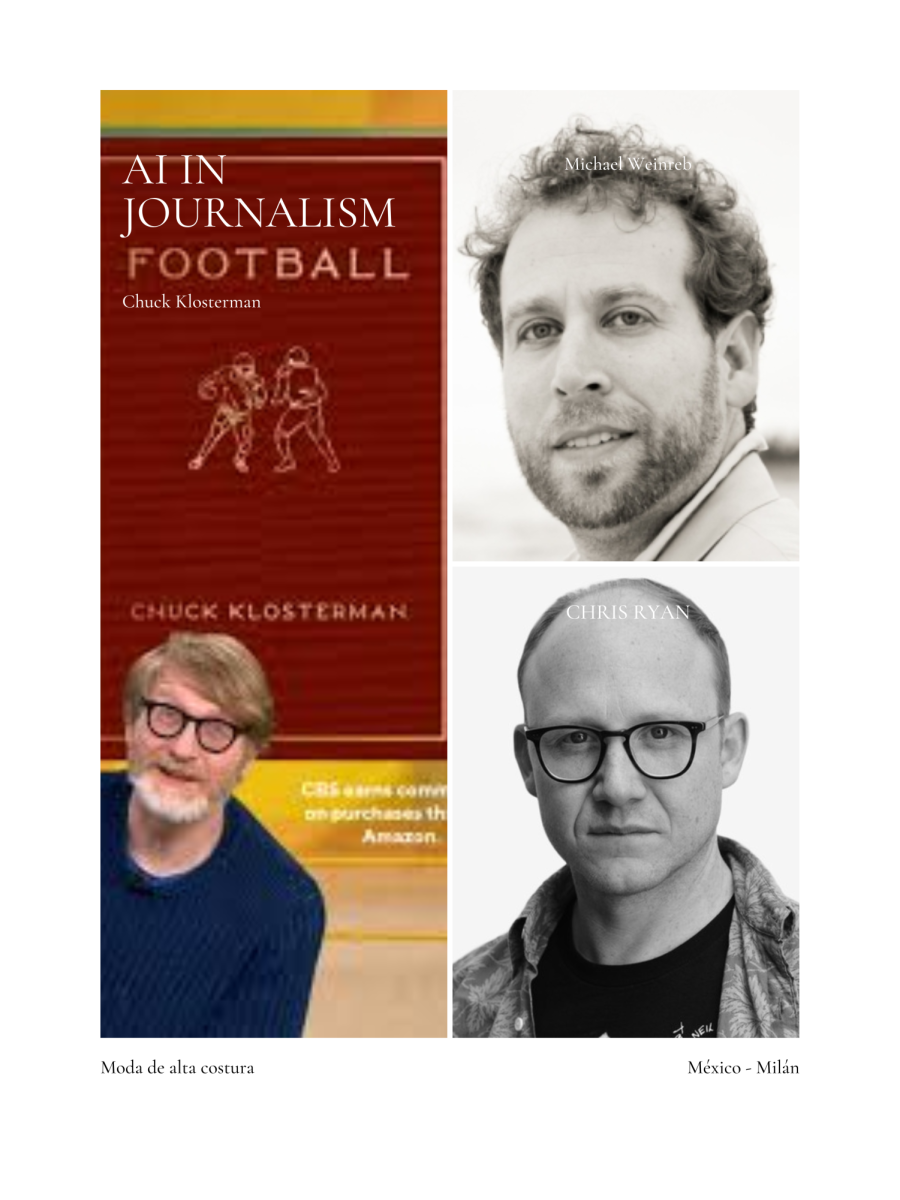
As someone interested in a career in journalism, I reached out to some writers I admire. I was interested in seeing how they got their start, and where they see the industry headed with the rise of Artificial Intelligence (AI), and other technologies. I tracked down and interviewed the Ringer’s editorial director Chris Ryan, best selling author Chuck Klosterman, and award winning author, journalist, and screenwriter Michael Weinreb. Each writer has a vast history in the business, and strong opinions on the future, and its conflictions with Artificial Intelligence.
Chris Ryan, who now hosts The Rewatchables podcast from “The Ringer” has been a writer his whole life. “My dad was a journalist, so I always had (Journalism) in my house growing up,” He said, “As I got older, the thing I loved basically more than anything was music, but I couldn’t play. So I just manifested and externalized my love of music by writing about it.” Ryan began writing about another passion of his, sports. “I started writing about hoops on a blog,” he said, “In 2011 Chuck Klosterman reached out to me saying he was starting a website with ESPN 30-30 documentary founder Bill Simmons, and that he had recommended me as a soccer writer. Next thing I knew I was writing a soccer column for Grantland.” (Grantland was a sports and pop culture blog owned by ESPN.) “I then started podcasting, and it kind of rolled from there, when The Ringer came out of that.”
Chuck Klosterman, as mentioned by Chris Ryan, was one of the original founders of Grantland alongside Bill Simmons, but his passion for journalism started way earlier than that. “When I was in high school I wrote for the school newspaper, but I didn’t really think I was going to become a journalist, I just thought I would be a high school english teacher, and a basketball coach,” He continued, “In my first week at the University of North Dakota I found the college newspaper. I was utterly shocked to find out they paid you to do it.” “I loved doing it. I seemed to be pretty good at it, I liked the people I was working with. It sort of created a sense in my mind that this is my identity. I am a journalist, and I just almost instantly committed to it.” Since then Klosterman has written twelve books, and has been featured on countless podcasts and documentaries.
Michael Weinreb was also invested in journalism from a young age: “I took a journalism class in high school, and I started writing a bit for the school paper. I then started writing for our local paper in the small town where Penn State is located, and they had a youth page. It continued in college at Penn State which was my main source of journalism education.” Since then, Weinreb has written in numerous publications including The Ringer, The Atlantic, ESPN, Grantland, and others.
Recently, the future of journalism has been in question with the expansion of artificial intelligence and other technologies. The Washington Post just laid off 33% of its employees. Though AI will gradually take lots of jobs in journalism, these journalists believe that AI won’t nearly be able to take over a market with such a vast history. “There is still going to be a need for journalists in some way shape or form” It’s just finding that voice. That uniqueness that AI is never going to have” said Weinreb. I think what’s going to happen is that AI is going to become a massive research tool,” said Chris Ryan. “I think journalists are already using it for their research.” It seems as though there will always be a need for journalists in society, each with a unique voice and their own opinions. This being said, technology has already had numerous benefits in the journalism field. “I think in some ways it’s never been easier for somebody to see their words published. Things like social media, and publishing platforms like substack,” said Ryan. Young journalists’ ideas and opinions are heard much more commonly in this day in age, when publishing on a public social media platform is so easy. “The principles of what is good about journalism or what makes journalism haven’t changed. The real journalism comes when you’re talking to someone who doesn’t want to talk to you or who doesn’t want to tell the truth” said Klosterman.
Overall, the future of journalism, and its relationship with artificial intelligence is extremely unpredictable. I don’t believe that AI will have the ability to form its own opinions, and its true voice the same way a human writer, or commentator can. It was promising to hear that some of my favorite journalists, authors, and podcasters believe that journalism will keep its prevalence in years to come. Journalism has been one of the most important professions throughout history, and will continue to be for years to come. Listen to Chris Ryan on the Rewatchables Podcast weekly, find Chuck Klosterman on the Bill Simmons podcast every few months, and in his countless books, and Weinreb’s latest stories on Substack.