

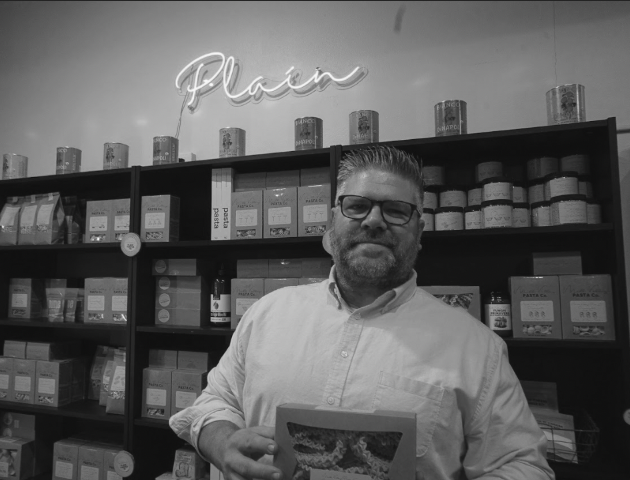
Walking into Mill Valley Pasta Company, customers are greeted by Tony Adams’ welcoming smile. Adams is more than just a friendly face; he is an asset to our community. As the owner, founder and head chef of Mill Valley Pasta Company, Adams has been able to help hundreds of people dealing with food insecurity. For years, the local pasta business has been quietly offering free meals to anyone who needs them, relying on one philosophy: No one should have to worry about where their next meal is coming from.
When Tony Adams taped a sign-up sheet to his Tam Valley mailbox in the summer of 2020, he wasn’t trying to launch a business. Adams was simply a furloughed chef with a vintage pasta machine and a desire to share his food with his neighbors. “I basically was like, hey, I’m Tony, I’m a chef. I’m not gonna kill ya. I miss cooking for people,” he said. It started slowly, with just a few neighbors reaching out. As interest increased, people started asking for more, now insisting on paying. By the end of the year, Adams had accidentally created Mill Valley Pasta Company, which now produces 1,000 to 1,500 pounds of pasta every week.
What started as a small act of connection during the pandemic has grown into one of Marin’s most meaningful hidden gems. At the heart of that generosity is something Adams calls the Uncle Tony Program. “For me, as a chef, we always want to feed people,” Adams said. “Growing up, my parents hid the fact that we were more food insecure than I realized. So I’ve always understood how hard it can be to ask for help.” The Uncle Tony program was built specifically to remove that barrier. Anyone can walk into a farmer’s market booth or store location and pick up an “Uncle Tony order,” no questions asked.
The program existed for nearly four years with minimal use, but when the Trump administration defunded SNAP benefits in October, Adams realized he had the power to grow his impact. “I uploaded a video to TikTok explaining the Uncle Tony Program … it had gone viral and we were being contacted by people from all over the U.S. and even a couple from the U.K., and Germany.”
At the beginning, their work to help others was local and small-scale. “We only ever had a couple of people take advantage of the program. Of course we’ve been lucky to be able to help a handful of people.” Adams said. What used to be one or two families a year has become dozens and dozens every single week, with messages coming not only from Marin, but across the country. Adams suddenly found himself shipping 40 to 50 pasta packages to people outside the Bay Area, something he never would have anticipated.
For Adams, the hardest part is balancing the explosion of need with the realities of running a small business. “I work 50 to 70 hours a week. I rarely take days off. And now I’m trying to track donations, read thousands of comments, and figure out who needs help,” he said. “I’m overwhelmed. This is the most overwhelmed I’ve been in a long time.” Still, he continues, driven by the belief that “when you have more food, you build a longer table, not a higher fence.”
As the movement grows, other small businesses are beginning to follow Adams’ lead, adopting their own versions of the Uncle Tony Program. Adams calls that “one of the coolest things to come out of all of this.”
Despite receiving countless donations in just weeks, Adams emphasizes that large food banks like ExtraFood Marin, SF-Marin Food Bank, and Respecting Our Elders often have greater power than small businesses. He urges community members to support those organizations with their time or money, especially going into the holiday season, when need remains high.
Above all, Adams wants the community to understand that he isn’t a hero, just someone who stepped up. “Sometimes you just need the loud person in the room to say, ‘Hey, I can help a little,’” he said. “Anyone can be that person. You don’t need a lot of resources to make a difference.” As SNAP benefits continue to fluctuate, Adams hopes the issue of hunger stays out of political battles. “Food shouldn’t be weaponized,” he said. “Food is a human right, and we’re going to keep doing whatever we can to make sure people have what they need.”